
Pre-participation cardiovascular screening aims to detect conditions that can lead to sudden cardiac death during exercise. Many tragic deaths of young people remain unexplained, but many could have been prevented.
Exercise-related sudden cardiac death is defined as a sudden, unexpected death during or shortly after exercise in a person who was otherwise healthy. Its incidence in athletes is about 2.1 per 100,000, compared with 0.7 per 100,000 in the general population.
Main causes of sudden cardiac death in athletes
Under 35 years:
- Hypertrophic cardiomyopathy
- Congenital coronary artery anomalies
- Long QT syndrome
- Brugada syndrome
- Short QT syndrome
- Catecholaminergic polymorphic ventricular tachycardia
- Myocarditis
- Arrhythmogenic right ventricular cardiomyopathy
Over 35 years:
- Coronary artery disease
- Congenital coronary artery anomalies
- Myocarditis
- Dilated cardiomyopathy
- Mitral valve prolapse
- Aortic stenosis
How screening is done
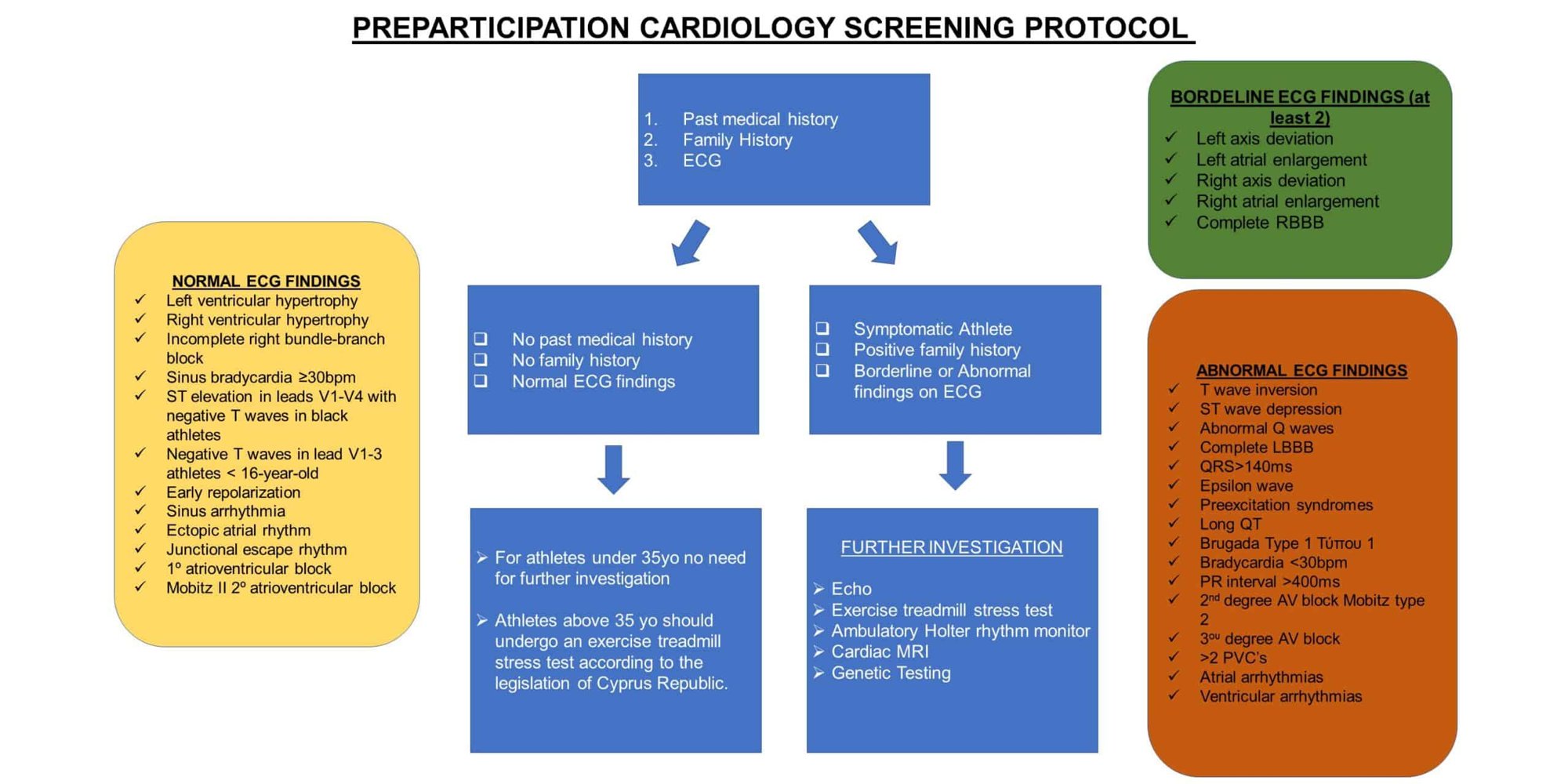
Athletes of all ages, amateur or professional, should have a preventive cardiology check at least once. It starts with a thorough history, with targeted questions about symptoms during exercise (chest pain, dizziness, unusual palpitations, fainting). A detailed family history is also essential, looking for sudden cardiac death in relatives under 50 and for young family members with heart disease.
This is followed by a full clinical examination, including careful listening to the heart and checking the peripheral pulses, and then an electrocardiogram, whose findings guide any further investigation (Figure 1).
A diagnosis does not automatically mean giving up sport. Appropriate further tests — imaging or even genetic testing — allow the doctor to advise the athlete on how, and which kind of, exercise is safe. For example, an athlete with myocarditis should stop exercising for at least 6 months and return only once all laboratory and imaging findings have normalised. Likewise, an athlete who carries a hypertrophic cardiomyopathy gene but has a normal echocardiogram can usually take part in all sports, with regular follow-up.
The goal of effective screening in professional and amateur athletes is to identify people at increased risk early and so greatly reduce the incidence of sudden cardiac death.
References
- Mont L, Pelliccia A, Sharma S, et al. Pre-participation cardiovascular evaluation for athletic participants to prevent sudden death: Position paper from the EHRA and the EACPR, branches of the ESC. Endorsed by APHRS, HRS, and SOLAECE. European Journal of Preventive Cardiology. 2016;24(1):41–69.
- Σανίδας Η, Αναστασάκης Α, Βέλλιου Μ, Τσιούφης Κ, Μπαρμπετσέας Ι. Καρδιολογικός Προαγωνιστικός Έλεγχος Αθλητών. Ελληνική Καρδιολογική Επιθεώρηση.
- Sharma S, Drezner J, Baggish A, et al. International recommendations for electrocardiographic interpretation in athletes. European Heart Journal. 2017;39(16):1466–1480.
This article is for information only and does not replace medical advice.