“What are my chances of a heart attack or stroke?” It is one of the most common questions in clinic. The European Society of Cardiology (ESC) answers it with SCORE2, a tool that gives the risk as a percentage. Here we explain what that percentage means, who it applies to and what it leaves out.
What SCORE2 calculates
SCORE2 estimates the chance of a heart attack, stroke or cardiovascular death over the next 10 years. SCORE2 is used for ages 40–69 and SCORE2-OP (for older persons) for ages 70–89; it accounts for the fact that other causes of death become more common with age.
It needs only six items: age, sex, smoking, systolic blood pressure, total and HDL cholesterol.
Risk is not the same across Europe. The ESC therefore groups countries into four clusters (low, moderate, high and very high risk) based on cardiovascular death rates. Cyprus belongs to the moderate-risk group. A Cypriot study (CESA) showed that this calibration estimates risk well in our population.
How to read the result
A result of 8% means that of 100 people with the same characteristics, about 8 will have a heart attack or stroke within 10 years. It does not mean that you certainly will or will not.
The latest update of the European guidelines (ESC/EAS 2025) classifies risk into four categories, with the same thresholds at all ages. The target for LDL (“bad”) cholesterol depends on the category:
- Low: below 2% — LDL target below 116 mg/dL.
- Moderate: 2% to below 10% — LDL target below 100 mg/dL.
- High: 10% to below 20% — LDL target below 70 mg/dL and a reduction of at least 50%.
- Very high: 20% or more — LDL target below 55 mg/dL and a reduction of at least 50%.
Age pushes the percentage up strongly, so in younger people even a “low” result deserves attention: if risk factors are left untreated, they have more years ahead to do damage. A low 10-year risk at 45 does not necessarily mean a low lifetime risk.
Who it does not apply to
SCORE2 is for apparently healthy people. It is not used if you have:
- Known cardiovascular disease (heart attack, coronary disease, stroke, peripheral arterial disease). Risk is already considered very high.
- Diabetes. SCORE2-Diabetes is used, which also accounts for glucose control and kidney function.
- Chronic kidney disease or familial hypercholesterolaemia, which raise risk on their own.
- A single very high value: total cholesterol above 310 mg/dL, LDL above 190 mg/dL or blood pressure of 180/110 or more. Risk is considered at least high whatever the percentage.
What it leaves out
Six items cannot describe a whole person. The ESC guidelines list risk modifiers: factors that may move you into a higher category, especially when your percentage is close to a threshold.
- Family history of premature cardiovascular disease (in a parent, brother or sister: men under 55, women under 65).
- Obesity and physical inactivity.
- Psychosocial stress, social deprivation and major psychiatric illness.
- Chronic inflammatory or autoimmune disease (e.g. rheumatoid arthritis, psoriasis), HIV infection and obstructive sleep apnoea.
- In women: early menopause, pre-eclampsia or high blood pressure in pregnancy.
- Family origin from high-risk populations (e.g. South Asia).
- Lipoprotein(a) – Lp(a): largely genetic and not shown on a standard lipid profile. The guidelines recommend measuring it at least once in a lifetime in every adult. A level above 50 mg/dL (105 nmol/L) is considered a risk-enhancing factor.
- Persistently raised high-sensitivity CRP (above 2 mg/L), as a marker of inflammation.
- Coronary artery calcium score: a short CT scan without contrast shows whether atherosclerosis is already present in the heart arteries. It helps when the treatment decision is borderline. A score above 300 places a person at very high risk.
Measuring blood pressure correctly
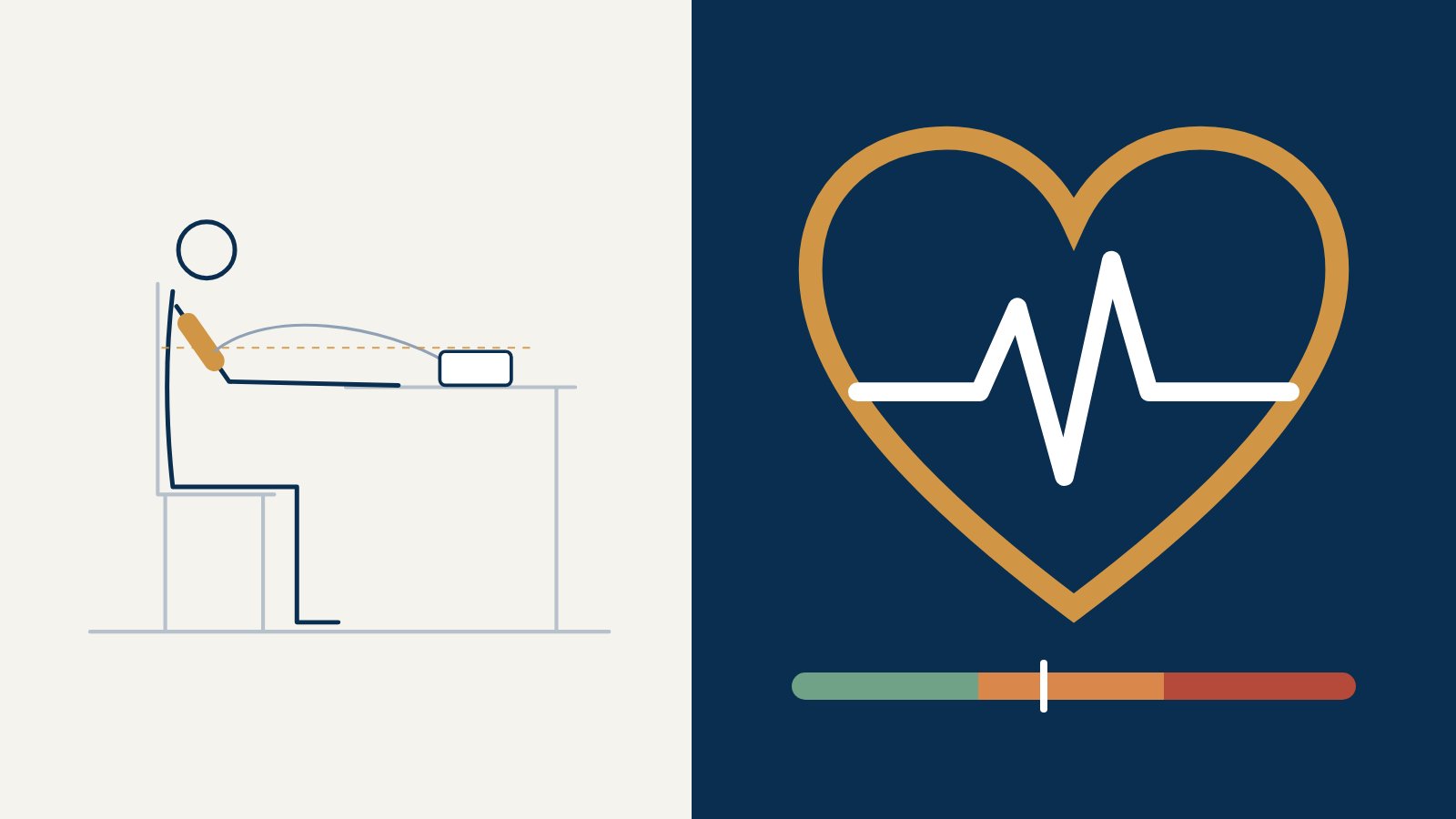
The blood pressure you enter has a large effect on the result, and a single reading can mislead. Use a validated upper-arm device. Sit quietly for 5 minutes with your back and arm supported and the cuff at heart level. Take two readings morning (before breakfast and medication) and evening for 7 days, and enter the average systolic.
The ESC guidelines (2024) classify the home average into three categories:
- Non-elevated blood pressure: below 120/70.
- Elevated blood pressure: 120/70 to below 135/85.
- Hypertension: 135/85 or more.
In the clinic the corresponding thresholds are 120/70 and 140/90, because clinic readings are usually slightly higher. The SCORE2 tool includes a drawing of the steps.
Your “heart age”
A percentage does not always mean much. That is why the European guidelines have long also used the idea of “risk age” or “vascular age”: the age at which a person of the same sex with ideal risk factors would have the same risk as you. If you are 52 and your heart “looks” 70, your risk is that of a 70-year-old with excellent numbers.
In the SCORE2 tool you will see your heart age and can try “what if” you stopped smoking or lowered your blood pressure or cholesterol. As ideal values we use: non-smoker, systolic pressure 110 mmHg and non-HDL cholesterol 133 mg/dL (3.45 mmol/L). Heart age is a way of picturing risk, not a measurement of the actual state of the heart.
What to do with the result
- Whatever it shows, lifestyle matters: stopping smoking, daily activity, a Mediterranean diet, a healthy weight, good sleep.
- If your risk is high or very high, the guidelines suggest considering medication for blood pressure or cholesterol as well.
- If you are close to a threshold or have one of the modifiers, a more detailed assessment (Lp(a), calcium score, arterial ultrasound) can clarify the picture.
- Any decision about treatment is made together with your doctor, based on your overall risk, your preferences and the likely benefits.
Work out your risk with the SCORE2 tool.
References
- SCORE2 working group and ESC Cardiovascular risk collaboration. SCORE2 risk prediction algorithms: new models to estimate 10-year risk of cardiovascular disease in Europe. Eur Heart J 2021;42:2439–54. doi:10.1093/eurheartj/ehab309
- SCORE2-OP working group and ESC Cardiovascular risk collaboration. SCORE2-OP risk prediction algorithms: estimating incident cardiovascular event risk in older persons in four geographical risk regions. Eur Heart J 2021;42:2455–67. doi:10.1093/eurheartj/ehab312
- Visseren FLJ, Mach F, Smulders YM, et al. 2021 ESC Guidelines on cardiovascular disease prevention in clinical practice. Eur Heart J 2021;42:3227–337. doi:10.1093/eurheartj/ehab484
- Mach F, Koskinas KC, Roeters van Lennep JE, et al. 2025 Focused Update of the 2019 ESC/EAS Guidelines for the management of dyslipidaemias. Eur Heart J 2025;46:4359–78.
- McEvoy JW, McCarthy CP, Bruno RM, et al. 2024 ESC Guidelines for the management of elevated blood pressure and hypertension. Eur Heart J 2024. doi:10.1093/eurheartj/ehae178
- Nicolaides AN, Griffin MB, Panayiotou AG, et al. Performance of SCORE2 and SCORE2-OP risk algorithms in a Cypriot cohort. Int Angiol 2022;41:492–9.
This article is for information only and does not replace medical advice.