Body mass index (BMI) is the best-known number for body weight. It is simple, free and useful. But it does not tell the whole story. In 2025 an international commission of The Lancet Diabetes & Endocrinology proposed a new way to diagnose obesity, and in 2026 a large study in Nature tested it in almost 850,000 people. What changes for you?
What BMI is
BMI is weight in kilograms divided by height in metres squared. A person 1.75 m tall weighing 92 kg has a BMI of 30. According to the World Health Organization, 18.5–24.9 is healthy weight, 25–29.9 overweight and 30 or more obesity.
BMI has been used for decades because it is easy to measure and, across populations, it tracks well with the risk of diabetes, cardiovascular disease and early death.
What BMI does not show
- It cannot tell fat from muscle. An athlete may have a BMI in the “obesity” range without excess fat.
- It does not show where the fat is. Fat around the abdominal organs is far more harmful to the heart and metabolism than fat on the hips and thighs.
- It is not the same for everyone. In people of Asian family origin, for example, risk rises at a lower BMI. Age and sex also change how BMI relates to body fat.
- It does not say whether weight is already harming health. Two people with the same BMI may differ: one healthy, the other already living with sleep apnoea, high blood pressure and knee pain.
Why the waist matters
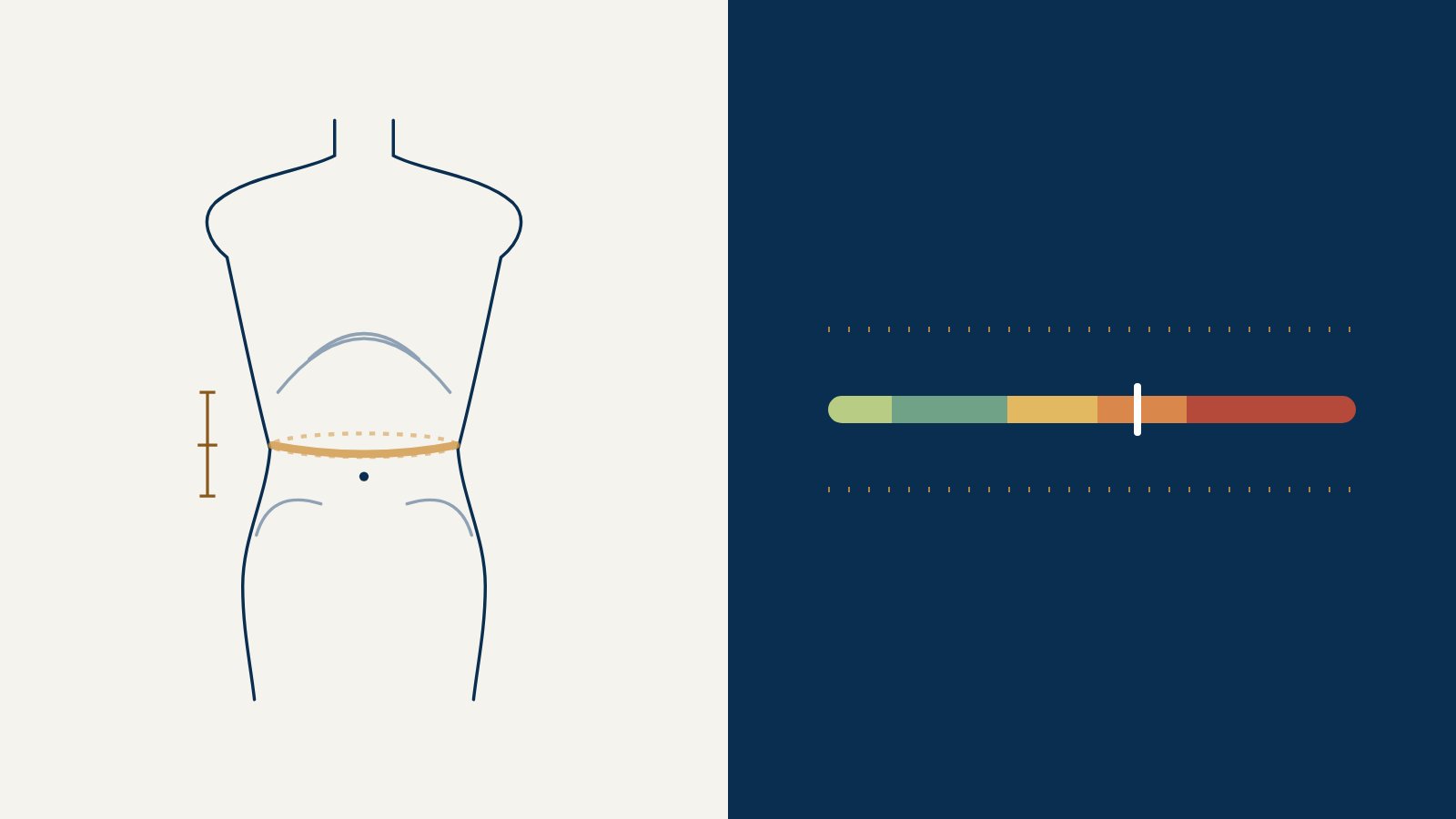
Waist circumference and waist-to-height ratio reflect abdominal fat. A simple rule: keep your waist to less than half your height. Measure standing, midway between the lowest rib and the top of the hip bone, at the end of a normal breath out. Our BMI and waist tool includes a drawing showing exactly where to measure.
The new definition: preclinical and clinical obesity
In January 2025 a commission of 58 experts from around the world (the Lancet Commission on Clinical Obesity, chaired by Professor Francesco Rubino) proposed two steps for diagnosis.
Step 1: confirm excess body fat. BMI alone is not enough. It needs at least one waist measure as well (waist circumference, waist-to-hip ratio or waist-to-height ratio), or two such measures whatever the BMI, or direct fat measurement (e.g. by DEXA). The exception: with a BMI above 40, excess fat is assumed.
Step 2: check whether the fat is already affecting how the body works.
- Clinical obesity is the chronic disease: excess fat has already caused organ dysfunction or limits everyday activities. The commission set 18 criteria for adults, including sleep apnoea, breathlessness, heart failure, atrial fibrillation, raised blood pressure, the combination of high blood glucose, high triglycerides and low HDL, fatty liver with fibrosis, chronic knee or hip pain, and significant difficulty with basic daily activities.
- Preclinical obesity means excess fat with organs still working normally. It is not an active disease, but it carries a higher risk for the future.
The distinction matters in practice: in clinical obesity, timely evidence-based treatment is recommended, as for any chronic disease. In preclinical obesity the aim is to lower risk — counselling, monitoring and, for those at high risk, treatment too.
What the large 2026 study showed
The Nature study analysed data from 844,108 adults in four large population cohorts in China, the UK, the USA and Spain. The main findings:
- BMI alone made errors in both directions: it wrongly labelled 1–3% of participants as having obesity and missed 5–9%.
- Clinical obesity accounted for roughly a quarter to a third of people with obesity (23–31%).
- People with clinical obesity had about a 69% higher risk of death, while with preclinical obesity the risk was only slightly raised (about 19%).
- Most people with preclinical obesity (77–91%) did not progress to clinical obesity within 10 years.
- Higher risk of death was linked to obesity confirmed with waist measures as well — not to obesity defined by BMI alone.
The debate continues
The new definition has not been accepted without objections. Scientific societies such as the European Association for the Study of Obesity (EASO) and the US Obesity Medicine Association have raised concerns that the “preclinical” label could delay or restrict treatment for people who would benefit. The authors reply that the aim is the right treatment for the right person, not withholding treatment.
Which waist thresholds are right is also still open. The familiar rule “waist under half your height” (ratio 0.5) is useful for spotting increased risk. To confirm obesity, however, the Nature study used higher thresholds (waist 102 cm in men and 88 cm in women of European origin, and a waist-to-height ratio of about 0.57–0.58). People above 0.5 only had no excess mortality. More data are needed to set the right thresholds for each population.
What this means for you
- BMI is still a good first step, but measure your waist too.
- The question is not only “how much do I weigh?” but also “is my weight already affecting my health?” — blood pressure, blood glucose, lipids, breathing, joints, the heart.
- If it is, obesity is treated as a chronic disease, with treatments of proven benefit. If not, prevention and regular follow-up come first.
- Any decision about treatment is always personal and made together with your doctor.
You can start with our BMI and waist tool and see whether a cardiometabolic assessment suits you.
References
- Rubino F, Cummings DE, Eckel RH, et al. Definition and diagnostic criteria of clinical obesity. Lancet Diabetes Endocrinol 2025;13:221–62. doi:10.1016/S2213-8587(24)00316-4
- Pan A, Yang S, Ramos R, et al. Validation of clinical and preclinical obesity across global cohorts. Nature 2026. doi:10.1038/s41586-026-11237-5
This article is for information only and does not replace medical advice.